
Bookie Bandit AI Betting Bot Review
A practical breakdown of Bookie Bandit, the high-ticket Whop betting software built around automation, +EV scanning, arbitrage monitoring, and bankroll discipline.
Affiliate disclosure: this site may earn a commission if you buy through Whop links. Betting involves risk and results are never guaranteed.

How The Bandit Workflow Operates
The better angle is not hype. It is a repeatable workflow: identify a candidate edge, check the math, control stake size, and keep records.
Scan
Monitors supported books and fantasy platforms for price gaps, props, and candidate +EV entries.
Model
Applies a rules-first process to filter noisy slips before they reach execution.
Size
Keeps bankroll discipline at the center of every betting workflow instead of chasing oversized parlays.
Execute
Built for bettors who want automation and alerts around repeatable, data-led decisions.
What The Offer Claims To Cover
Use the Whop checkout page to verify live details before subscribing. Pricing, access, platform support, and terms can change.
The 5,000-word buyer argument, broken into useful rooms
This page is built around the review framework: one costly lie, one mechanism, one number, then proof, caveats, tables, and a decision filter.
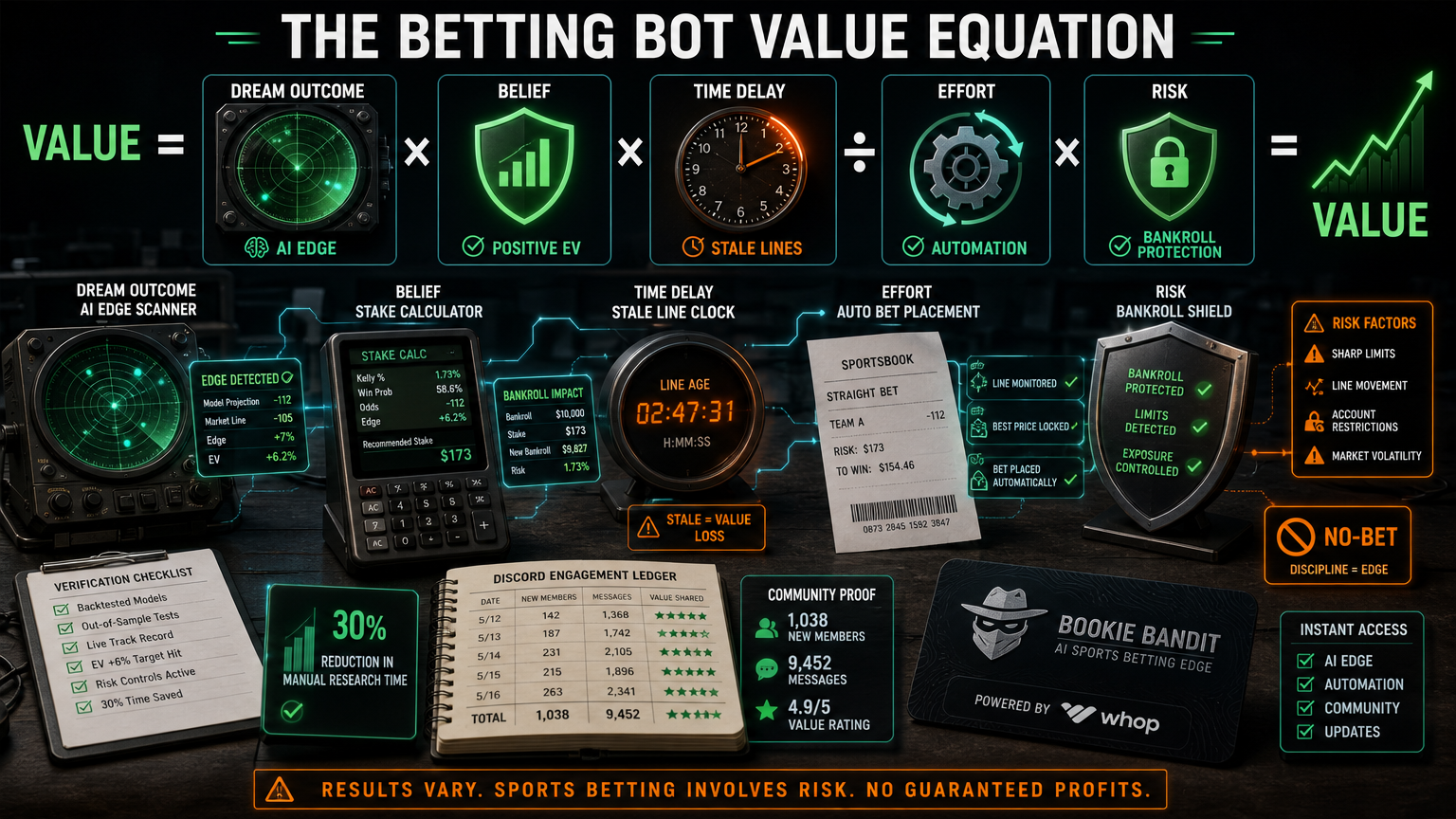
The bot is not the product. The workflow is the product.
The expensive lie in betting automation is simple: if the software is smart enough, the buyer can stop thinking. That is the sentence that drains bankrolls. It sounds modern. It sounds efficient. It is still wrong.
Bookie Bandit should be judged by one standard: does it make a serious bettor's process cleaner before money is at risk? A useful bot narrows the mess. It scans faster than a human, organizes candidate bets, and pushes the user toward a rule. A dangerous bot gives a reckless user more speed.
That is why the first section of this page is not a feature list. Feature lists create desire before judgment. The better order is pain, mechanism, math, caveat, then call to action. You need to feel the old room first: odds moving, tabs open, Discord lighting up, bankroll rules half-remembered, and one more slip that looks obvious because nobody wrote down what would make it a pass.
The value equation for this offer is not 'AI equals profit.' It is cleaner decisions multiplied by belief, divided by delay and effort. If Bookie Bandit raises decision quality and lowers research drag for a bettor who already has rules, the tool can be worth inspecting. If the buyer wants certainty, the offer should be skipped.
Verify current access, terms, and platform support before making a paid decision.
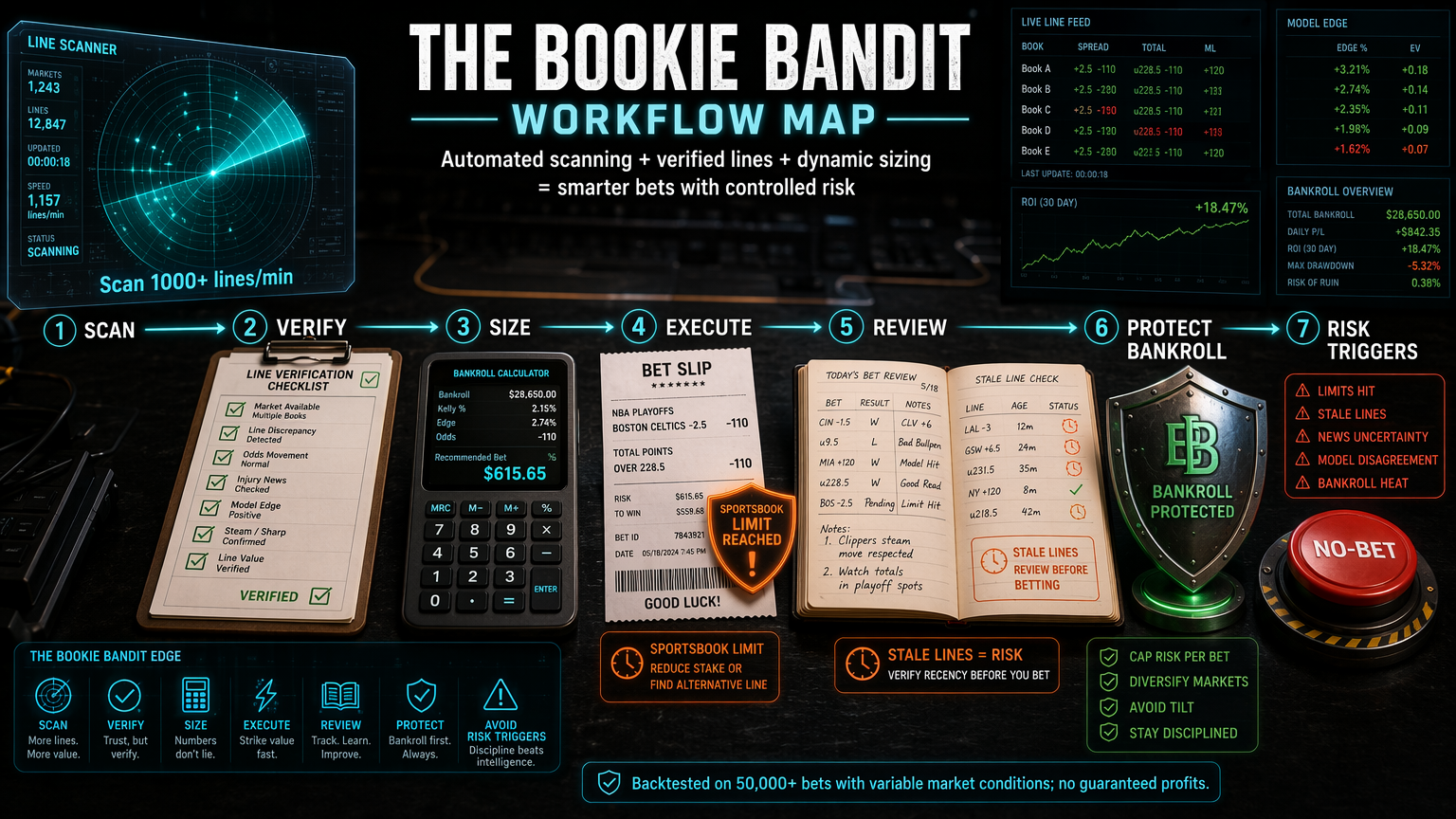
Scan, verify, size, execute, review. Miss one step and the edge leaks.
The named mechanism is the Bandit workflow. It is a five-part loop, not a magic button. First, scan for possible edges. Second, verify the market while the line is still alive. Third, size the stake against bankroll rules. Fourth, execute only if the rules still pass. Fifth, review the result without rewriting history.
This matters because every betting product tries to compress time. Time compression is valuable when the inputs are good. It is expensive when the inputs are bad. The same alert that helps a prepared bettor move faster can push an unprepared bettor into a rushed bet with a bigger subscription bill attached.
A good landing page has to show that tradeoff in public. It cannot bury the caveat in the footer. The warning is part of the sell because the right buyer is not looking for fairy dust. The right buyer is looking for tools that respect the parts of betting that still hurt: limits, stale lines, variance, platform rules, and user discipline.
That is why the workflow is drawn as a loop across this page and the articles. The loop makes the promise concrete. It says: here is where the tool may help; here is where you still have work; here is where a bad user can turn speed into damage.
Verify current access, terms, and platform support before making a paid decision.
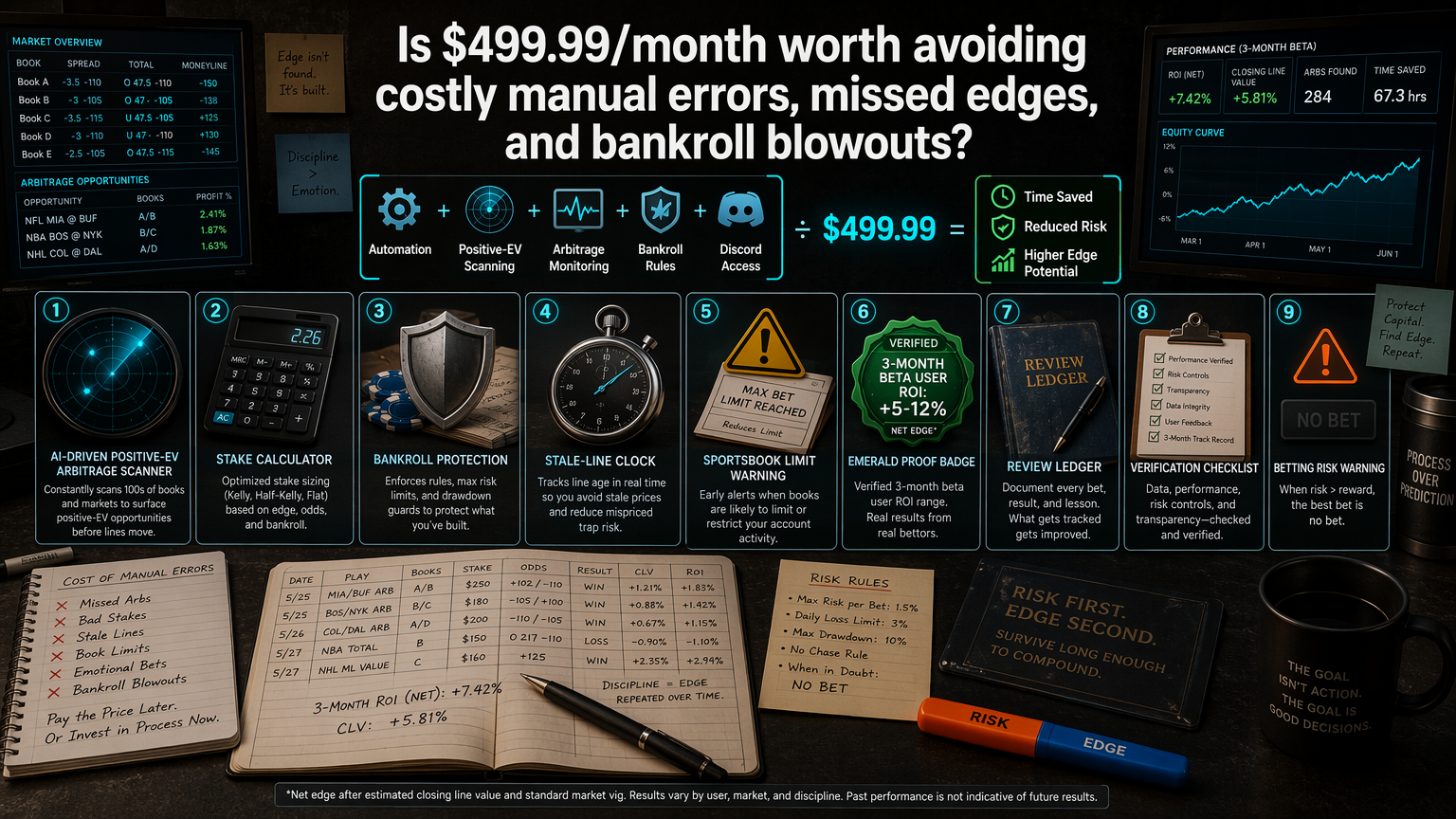
The $499.99 monthly question is not 'can I afford it?' It is 'can my process use it?'
Price has to be framed against the cost of the problem continuing. But in betting, that does not mean inventing profit math. It means naming the subscription drag honestly. A $499.99 monthly product creates pressure. If that pressure makes the buyer stake larger just to justify the fee, the product has already changed behavior in the wrong direction.
The clean question is operational. How many days each week will you use the scanner? Which bet types will it touch? What bankroll rules stop a bet? What counts as a successful week if results are noisy? What would make you cancel after seven days, thirty days, or one billing cycle?
A serious buyer writes those answers down before joining. That single act changes the purchase. Now the user is not buying hope. They are buying a test. The product either improves the test or it does not. The emotional fog gets replaced by a checklist.
This is the Hormozi price frame adapted for a risk product: compare the price to the buyer's real alternative, but do not pretend the alternative is guaranteed profit. The alternative might be wasted time, sloppy staking, missed line movement, or paying for cheaper communities that never change behavior. The buyer still has to verify that Bookie Bandit solves any of those problems for them.
Verify current access, terms, and platform support before making a paid decision.
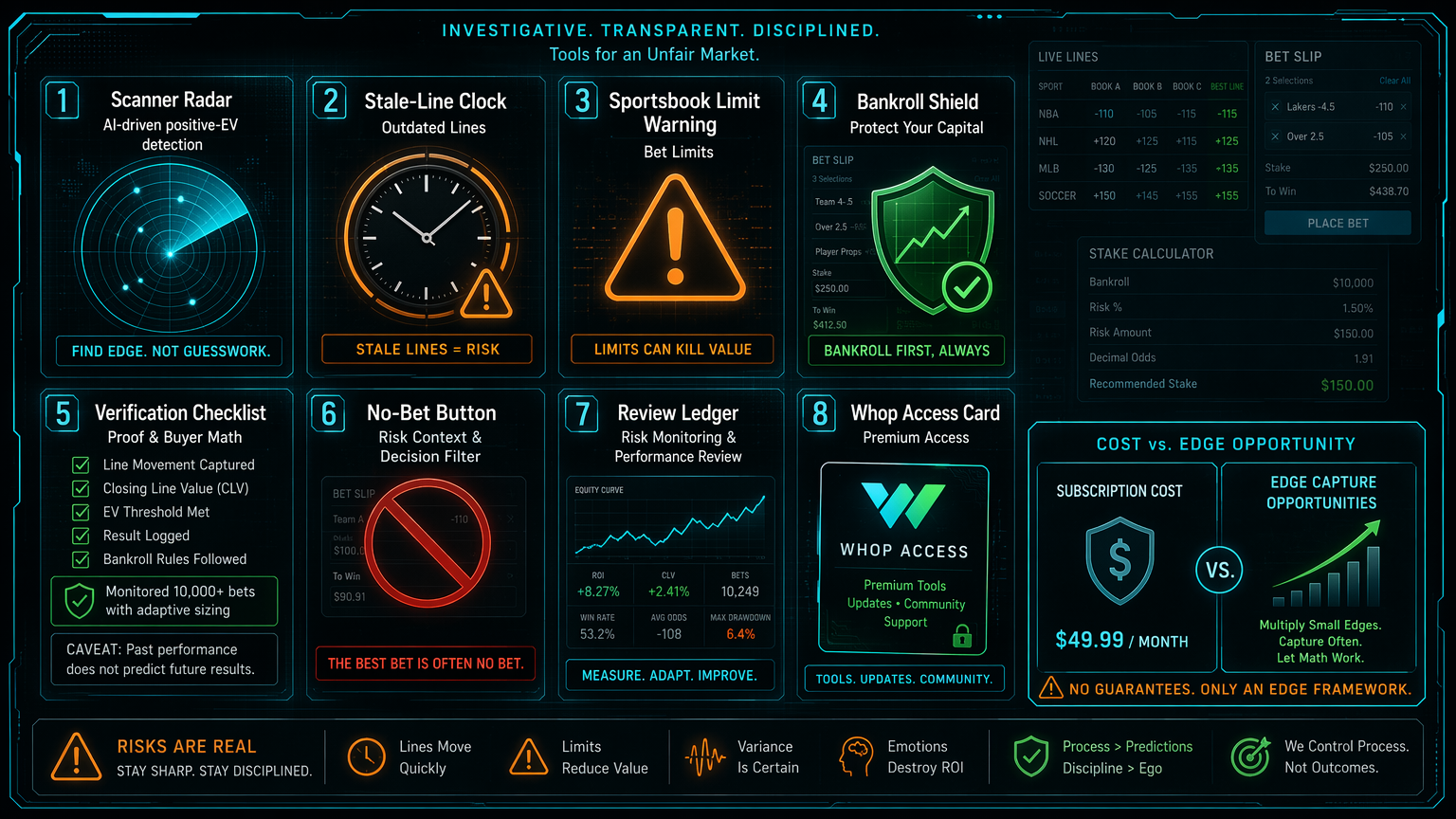
Trust comes from showing the caveats before the button.
Most betting pages spend proof badly. They lead with confidence, screenshots, or big claims, then hide the uncomfortable part. That order trains the reader to distrust the page. This version does the opposite. It spends honesty early so the call to action can be cleaner later.
The proof stack here is deliberately conservative. It uses the Whop product path, the stated Pro price in the site copy, the free Discord path, the claimed mechanism, and the risk disclaimers. It does not promise win rates. It does not imply typical results. It does not treat a testimonial as a forecast.
That restraint is not weakness. It is the credibility engine. A buyer considering a premium betting bot already knows the pitch can get wild. When the page says who should skip it, what can go wrong, and which claims need verification on Whop, the remaining endorsement has more force.
The strongest copy is not louder. It is harder to dismiss. Concrete terms beat hype: stale line, stake split, bankroll rule, book limit, review log, cancellation rule. Those are the nouns a real bettor recognizes. Those are the nouns that make the page feel written from inside the room.
Verify current access, terms, and platform support before making a paid decision.
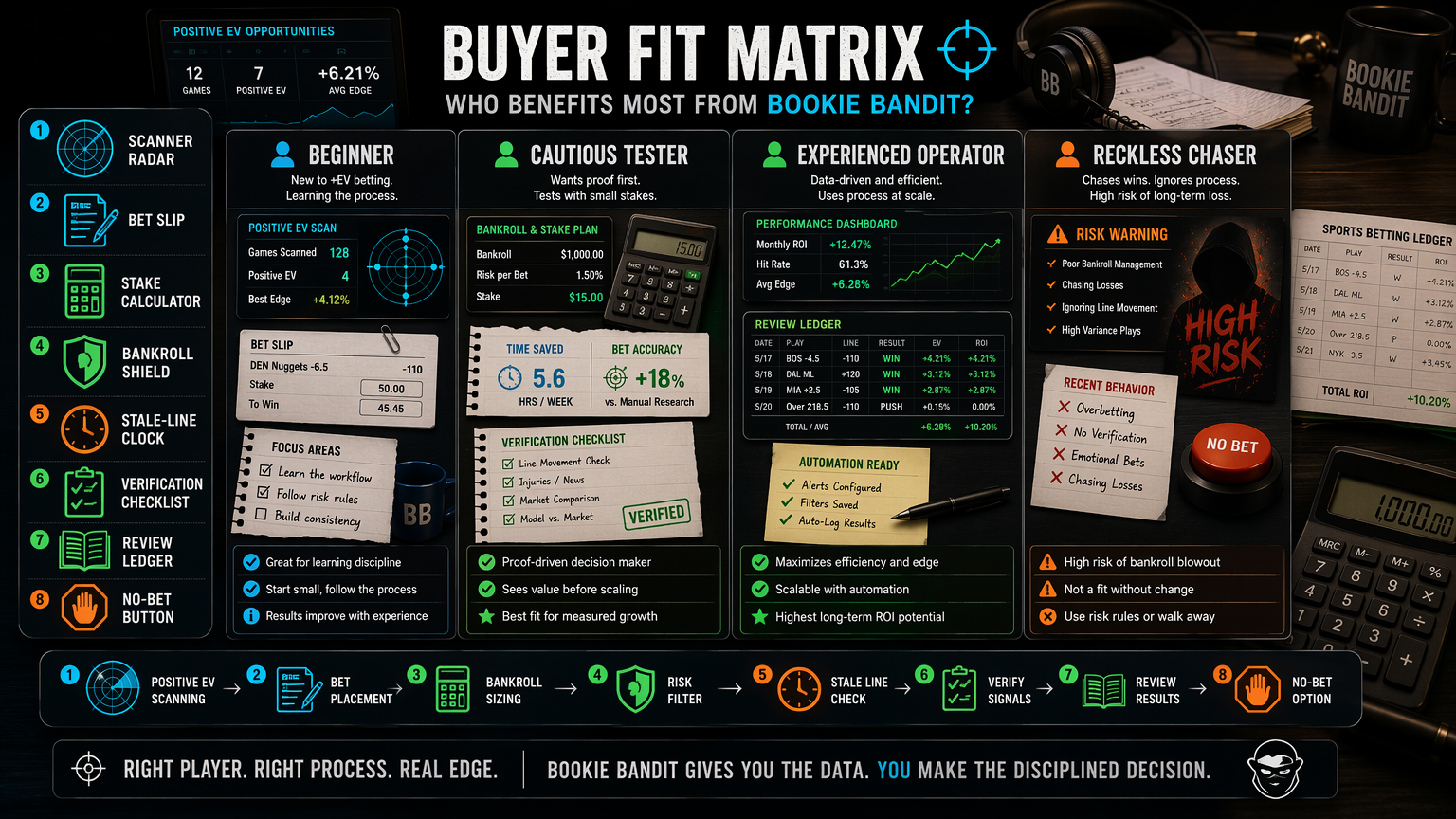
The right buyer does not need more hype. They need a cleaner yes or no.
Bookie Bandit is a fit when the buyer can name the exact workflow they want improved. It is a fit when they already understand bankroll management, platform limitations, and the difference between an alert and an executed edge. It is a fit when the free Discord has been inspected and the Pro tier has a defined job.
It is not a fit when the buyer is trying to outrun losses, replace judgment, or turn a subscription into permission to bet more. It is not a fit when the buyer cannot explain what will be tested in the first week. It is not a fit when the product cost creates pressure to chase.
That is the final decision filter. Join free if you need to inspect the room. Consider Pro only if the workflow has a written job and the monthly price fits your bankroll without changing your stake discipline. Skip it if what you want is certainty.
A landing page with 5,000 words should not feel long. It should feel like a series of useful rooms: the lie, the mechanism, the math, the caveats, the tables, the checklist, the verdict. Each room should make the buyer more informed, not merely more excited.
Verify current access, terms, and platform support before making a paid decision.
Picture the old workflow before you picture the bot.
It is late. The slate is already moving. One tab has PrizePicks. One tab has Underdog. One tab has an odds screen. A Discord ping lands with a confident sentence and no context. You are not stupid. You are overloaded. That is the room most betting software is sold into.
The bad version of that room turns every new alert into pressure. The line might move. Someone else might get there first. The slip might be gone. The body starts making the decision before the brain has finished checking it. That is why speed without structure is dangerous.
A useful automation product changes the room. It does not make the room risk-free. It turns scattered inputs into a sequence. It slows the right parts down and speeds the mechanical parts up. It gives you a place to put the question: is this still a bet after verification, or was it only exciting when it arrived?
That is the story this page is built to tell. The buyer is not a cartoon degenerate and not a passive-income fantasy. The buyer is a person trying to make decisions in a noisy market. The offer only matters if it changes that market room in a practical way.
Verify current access, terms, and platform support before making a paid decision.
The real objections are not technical. They are behavioral.
A buyer rarely says the full objection out loud. They say, 'Does it work?' What they mean is larger. Will it work for my bankroll, my platforms, my schedule, my discipline, my tolerance for losses, and my ability to stop when the system says stop?
That is why a serious page has to answer more than feature questions. It has to answer effort and sacrifice. What does the buyer still have to do? What can they stop doing? What does the product take off their plate? What responsibility remains theirs even after the subscription starts?
Bookie Bandit can reduce research drag if the workflow fits. It can make scanning more systematic. It can give a user a cleaner operating loop. But the buyer still owns account risk, bankroll limits, platform terms, stale-line checks, emotional control, and the choice to pass.
That clarity makes the page stronger. A weak page hides responsibility because it is afraid the buyer will leave. A strong page names responsibility because the right buyer wants to know where the edges of the promise are.
Verify current access, terms, and platform support before making a paid decision.
The first seven days should test decisions, not chase a screenshot.
Day one is not for betting harder. Day one is for mapping the workflow. Write the platforms you use, the bet types you understand, the bankroll rule you will not violate, and the exact conditions that make you pass. If you cannot write those conditions, start with education before automation.
Day two and three are for observation. Watch what the system surfaces. Do not judge by whether one candidate wins. Judge by whether the candidate arrives with enough context to make a better decision. Did the tool reduce tab chaos? Did it expose a stale line? Did it force a sizing conversation?
Day four and five are for small controlled use, if the free or paid access supports it and the terms allow it. Keep the unit small. Log everything. Log the skipped bets too, because skipped bad decisions are often where the product creates value. A betting journal that only records wins is not a journal. It is a highlight reel.
Day six and seven are for review. Would you have made worse decisions without the system? Did the product reduce effort without increasing recklessness? Did the cost create pressure? If the answer is unclear, do not upgrade the story in your head. Extend the test or cancel.
Verify current access, terms, and platform support before making a paid decision.
A premium bot should make you more conservative, not more aggressive.
This is the price paradox. The higher the subscription cost, the more disciplined the buyer has to become. A cheap tool can be ignored. A premium tool creates gravity. The danger is that the buyer starts making the market pay back the subscription by forcing volume.
That is backwards. The subscription should earn its place by improving selection, not by pressuring more action. A tool that helps you pass on weak spots can be more valuable than a tool that produces more bets. The hardest button in betting is not 'place bet.' It is 'skip.'
The right price frame compares Bookie Bandit against the current leak: wasted time, unlogged mistakes, rushed entries, missed verification, scattered research, and paying for weaker tools that never change behavior. But those comparisons have to stay grounded. They are not promises of recovered money. They are categories to inspect.
If the product helps reduce a real leak, the price conversation becomes practical. If the buyer cannot find the leak, the price conversation becomes emotional. Emotional price math is how people talk themselves into tools they do not use.
Verify current access, terms, and platform support before making a paid decision.
The mechanism has to survive contact with limits, rules, and time.
Every betting mechanism sounds clean in a diagram. The market makes it messy. Lines move. Books limit accounts. Platform rules change. Props disappear. A number that looked useful five minutes ago can become stale before the slip is built.
That is why the mechanism cannot be described as 'AI finds winners.' The more honest mechanism is narrower and stronger: the system helps surface candidate opportunities, then the user or automation flow has to verify, size, execute, and review against constraints.
Those constraints are not footnotes. They are the work. A buyer who understands constraints can use automation as leverage. A buyer who ignores constraints will treat every warning as an inconvenience and every alert as a command.
The page repeats this because repetition creates safety. Scan. Verify. Size. Execute. Review. The words should become boring by the end, because boring rules are what keep a sharp tool from cutting the wrong thing.
Verify current access, terms, and platform support before making a paid decision.
Sometimes the best alternative is a spreadsheet and restraint.
A fair review has to admit when a paid product is not the best next step. If a bettor has no bankroll rule, no logged history, and no stable platform routine, the next purchase should probably not be a premium bot. The next purchase might be time, education, and a spreadsheet.
That does not make Bookie Bandit weak. It makes the recommendation sharper. A product built for workflow compression needs a workflow to compress. Without one, the buyer is asking software to create discipline from nothing.
The alternatives are simple. Manual tracking if the buyer needs fundamentals. Free Discord if they need to inspect the community and language. A narrow scanner if they only care about one workflow. Pro access if they can use the full loop and the cost fits without changing unit size.
This kind of comparison sells better because it gives the buyer a way to disagree without feeling tricked. If they are not ready, they know why. If they are ready, the CTA feels cleaner because the page has already filtered the wrong use cases.
Verify current access, terms, and platform support before making a paid decision.
The cleanest yes is written before checkout.
Before clicking anything, write one paragraph. I am considering Bookie Bandit because it may improve this exact workflow. I will use it this many days per week. I will keep my unit size here. I will cancel if these conditions are not met. I understand betting can lose money.
That paragraph is more valuable than another testimonial. It turns the buyer from spectator into operator. It makes the purchase measurable. It protects the buyer from rewriting the decision after the first emotional result.
If writing that paragraph feels impossible, the correct next step is the free path. Inspect the room. Read the articles. Learn the mechanism. Build a small manual process. Then come back to the Pro decision with clearer eyes.
If writing that paragraph feels easy, the product has a real job. That is the buyer this page is for: not someone looking for certainty, but someone looking for a faster, cleaner way to run a process they already respect.
Verify current access, terms, and platform support before making a paid decision.
The whole page should make one belief hard to keep.
The old belief is comfortable: a smarter betting tool will make the decision easy. The new belief is stricter: a smarter betting tool only helps when the buyer brings a process worth speeding up. Every section on this lander pushes that swap.
That is why the page keeps returning to the same nouns. Workflow. Stake. Line. Limit. Log. Pass. Those words are not decoration. They are the language of the buyer who has moved past entertainment and started treating the process like an operating system.
A weaker page would keep changing angles because it does not trust its own argument. This page repeats the mechanism from different sides. First as pain. Then as diagram. Then as price math. Then as caveat. Then as checklist. Repetition is useful when the repeated thing is the truth the buyer needs to remember at the moment of purchase.
By the time the CTA appears, the reader should not feel whipped into a frenzy. They should feel sorted. Either the tool has a job, or it does not. Either the price fits the system, or it does not. Either the buyer can write the rules, or the free path is the better next move.
That is immaculate copy in this category: not louder promises, but cleaner thinking. The copy moves fast, but the claims stay sober. The design feels sharp, but the risk remains visible. The reader gets momentum without being pushed off a cliff.
Verify current access, terms, and platform support before making a paid decision.
Every visual should teach the decision faster than another paragraph.
The infographics are not there to decorate empty space. Each one has a job. The value-equation graphic explains why a bot can be valuable without promising profit. The workflow map shows why detection is only one step. The risk ledger keeps the caveats visible. The buyer matrix turns fit into a concrete decision.
This matters because a long landing page can fail in two ways. It can be too thin, leaving the buyer unconvinced. Or it can be too dense, forcing the buyer to read a legal memo before they understand the offer. The answer is structured density: tables, cards, diagrams, lists, scorecards, and short CTA bands.
A reader should be able to skim the page and still understand the argument. They should see the bot, the workflow, the price, the risks, the alternatives, and the decision filter before reading every word. Then the body copy rewards deeper reading with sharper reasoning.
That is why the blog articles use hero and section images too. A 4,000-word article needs rest stops. Each H2 gets a visual anchor. Each table compresses a comparison. Each callout names the number or caveat the reader should not miss.
The visual system also keeps the brand coherent. Dark terminal base, cyan signal, emerald proof, orange caution, white labels. It feels like betting software without pretending to be a sportsbook. It looks technical without drowning the reader in fake metrics.
Verify current access, terms, and platform support before making a paid decision.
The CTA sequence should lower risk step by step.
There are two CTAs because there are two honest next steps. Some readers should inspect the free Discord. Some readers should evaluate Pro. Treating both buyers the same would be lazy. It would push beginners too hard and slow down prepared operators.
The free CTA is the low-friction door. It gives cautious buyers a way to inspect the room, language, cadence, and community without pretending they are ready for automation. That matters because the first yes should be easy and sane.
The Pro CTA is the high-intent door. It belongs after the mechanism, price frame, caveats, and scorecard. A serious buyer can click it with clearer expectations because the page has already explained what the product is not.
The middle CTA bands exist to prevent the page from becoming passive. After a major idea lands, the buyer gets a small action: check access, inspect terms, compare options. The buttons are not random interruptions. They are staged commitments placed after useful context.
That sequencing follows the behavior rule from the writing system: arrange conditions, do not beg. The page should make the next good action obvious. If the buyer is unclear, the good action is free inspection. If the buyer is clear, the good action is verifying Pro on Whop.
Choose by workflow, not by hype
The right comparison is not bot versus no bot. It is which workflow gives you the least fragile decision process.
| Option | Upside | Risk | Best fit |
|---|---|---|---|
| Manual betting | Cheap, flexible, full control | Slow research, missed lines, emotional drift | Best for disciplined bettors who already log every decision |
| Pick seller | Simple to follow | Little visibility into process or sizing | Best only when proof and accountability are unusually strong |
| Free Discord | Low-risk way to inspect community quality | Limited automation and uneven signal quality | Best first step for beginners |
| Bookie Bandit Pro | Automation, scanning, and workflow compression | High monthly cost and execution risk | Best for experienced bettors with written rules |
Seven-point buyer scorecard
Can you name the exact bet types and platforms it will touch?
Can you pay the subscription without increasing unit size?
Do you know who verifies stale lines and platform rules?
What makes you cancel after the first billing cycle?
Where will you log passes, bets, losses, and misses?
Can you handle variance without changing the system?
Have you inspected the Discord before Pro?
Plus/minus decision grid
Cleaner research, faster candidate review, less tab chaos
Faster chasing, bigger fee pressure, more emotional decisions
You keep capital safe while testing free access first
The old leak stays: scattered research and no review loop
Verify current access, terms, and platform support before making a paid decision.
Six rules to read before the checkout page
This is the final compression of the page. If these rules feel too strict, start free. If they feel obvious, you are closer to the buyer profile the Pro offer is speaking to.
Clear rules beat louder betting noise every time.
The old leak
The old leak is not one bad bet. It is the repeatable habit of entering a position before the pass criteria are written. A bot cannot repair that after the fact. It can only help if the buyer gives it a rule to enforce.
The first win
The first win should be clarity, not profit. If the product helps you see why three tempting bets should be skipped, that is useful signal. The bankroll does not care whether discipline feels exciting.
The proof rule
Screenshots are not a system. Treat every proof point as a prompt for verification: what market, what stake, what timing, what account condition, what sample size, what downside?
The buyer identity
The right buyer is not trying to become lucky. The right buyer is trying to become less chaotic. That identity shift matters because chaotic users turn every powerful tool into a faster mistake machine.
The cancel rule
Before Pro access, decide what would make you cancel. No clear workflow improvement, no regular usage, pressure to increase unit size, unclear platform fit, or emotional betting should all be enough.
The final standard
Bookie Bandit earns a serious look only when it changes decisions before the bet. After-the-fact excitement is cheap. Pre-bet structure is the asset.
The quiet edge
The quiet edge is not a louder alert. It is the ability to ignore an alert because the verification step failed. A product that helps you do less bad betting can matter more than a product that helps you do more betting.
The pressure test
Ask what happens on a losing week. If the answer is larger stakes, frantic upgrades, or revenge volume, the system is not ready. A serious workflow should stay recognizable when the last five decisions felt bad.
The free path
Free access is not a consolation prize. It is a useful filter. You can inspect language, speed, moderation, examples, and whether the room talks like operators or like people trying to sell each other certainty.
The pro path
Pro access should feel boringly specific. I need this scanner for these markets. I will use it on these days. I will cap exposure here. I will review here. Specificity is what turns a subscription into an operating decision.
The last question
Before paying, ask whether Bookie Bandit will make tomorrow's betting process smaller, clearer, and easier to audit. If yes, inspect the offer. If no, more copy should not move you. The page has done its job when the next step is obvious. A serious betting tool should leave you calmer, not louder; more selective, not more frantic; more aware of downside, not less. That is the standard.
Start Free Or Evaluate Pro
Free Discord
A lower-risk way to inspect community quality before paying for automation.
- General community access
- Introductory betting education
- Limited free slips or examples when available
Bookie Bandit Pro
High-ticket automation for bettors who can justify the cost and understand betting risk.
- Automated bot workflow for supported platforms
- Arbitrage and +EV monitoring
- Bankroll sizing framework
Questions Before You Buy
Is Bookie Bandit a guaranteed profit system?
No. Any betting product can lose money, and no tool can remove variance, limits, changing lines, or user risk. Treat it as software and education, not a guarantee.
Who is this best suited for?
It is most relevant for experienced bettors who already understand bankroll management, line movement, platform rules, and the risk of automated betting workflows.
Should beginners start with Pro?
Most beginners should start with the free Discord or educational material first. The Pro tier is expensive, so the monthly cost should make sense relative to your bankroll and experience.
Where is access handled?
Access is handled through Whop. Use the product page to confirm current pricing, refund terms, platform support, and subscription details before buying.